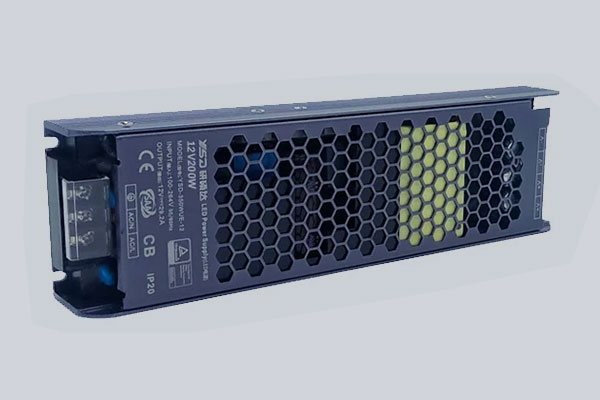
How to choose an LED power supply
Choosing an LED power supply requires knowledge of your power source, the LEDs that you’re powering, as well as the conditions that they’ll be operating in, and where and how it will be installed.
Wattage
Find out how many watts your LED light will consume, if you’re planning on powering multiple lights with one power supply then you will need to sum the wattages in order to calculate the total watts they will use. Your LED power supply will need to be large enough to exceed this overall wattage. Typically, it’s recommended to buy a power supply that exceeds the wattage required by at least 20%, so that you can guarantee consistent performance.
Voltage/Current
Make sure to note the required input voltage of the LEDs that you are supplying power to as this will dictate the type of LED power supply that you will choose. LEDs requiring a fixed output current will require constant-current drivers. On the other hand, LEDs that require a fixed output voltage will need to be powered by constant-voltage drivers.
You’ll also need to confirm the line voltage that you will be working with, this varies depending on what country you are operating in. LED power supplies can be designed for low-line AC power, high-line AC power or a full range of AC power.
Using Dimmable LEDs?
If you’re using dimmable LEDs then you’ll need a power supply with dimming capabilities. Dimmable LED power supplies typically use one of two control types: pulse-width modulation dimming (PWM dimming), or TRIAC dimming (Triode for alternating current).
PWM dimmers pulse lights at high frequencies to change our perception of light. These dimmers are usually built into LED strip lights functioning on the 12VDC side of the circuit. Wall-mounted or remote PWM dimmers can be used on all power supplies if needed.
TRIAC dimming can only be used when power supplies qualify for alternating current (TRIAC) dimming – check the specifications of your power supply. TRIAC dimming power supplies create a change in power on the AC input side, which therefore varies the DC output, which then controls the brightness of your LEDs.
Operating Temperature
Your operating conditions will also determine the type of LED power supply that you choose. Power supplies have safe operating temperatures that should be adhered to in order to provide optimal performance and to prevent overheating. Consider the space that you are installing the power supply and ensure that you allow for appropriate ventilation of the unit.
Weather Conditions
Consider the weather conditions that your LED power supply will be operating in and choose your unit accordingly. Power supplies have IP (ingress protection) ratings that describe the degree to which the unit can resist the size of solids and pressure of liquids. This allows you to match your power supply’s resistance with the worst-case conditions that it could be operating in. For example, an IP67 rating is given to a unit that provides limited protection against dust and can be immersed between 15cm and 1m underwater.
Size & Shape
On a practical note, you’ll need to ensure that the LED power supply you choose is the right size and shape for your needs. If you are buying a replacement power supply then you’ll want to ensure that the unit fits in the space you have with enough space for ventilation to prevent over-heating.
Efficiency
The efficiency percentage of a power supply indicates the amount of power that is actually being used to light your LEDs. The higher this number, the more power you’ll be saving, so it makes sense to choose an LED power supply with an efficiency percentage of at least 80%.
Safety Approvals
There are a number of different safety approvals and classes that are used to differentiate power supplies. UL Class 2 drivers will comply with standard UL1310, which means that no major safety protection is required at the LED level and there is no risk of fire or electric shock. These drivers are limited at different voltages depending on their operating conditions, as such there are restrictions on how many LEDs Class 2 drivers can operate.
UL Class 1 drivers have high-voltage outputs and require additional safety protection; however, they can also operate more LEDs, making them more efficient than their UL Class 2 counterparts when a larger number of LEDs need to be powered.
Related information
How to choose an LED power supply