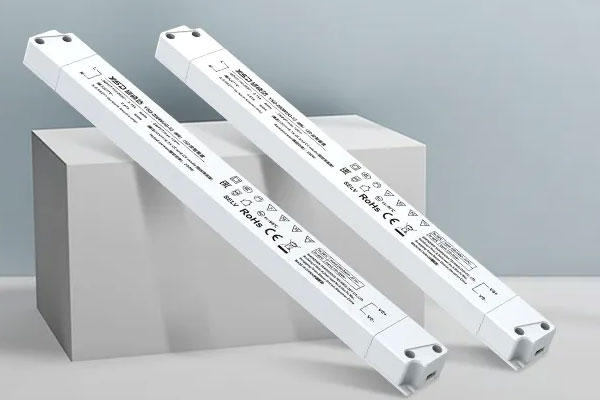
Constant Current vs Constant Voltage LED Drivers
Constant current LED drivers are used with LEDs that require a steady current but varying Voltages as the wattage (total power load) in each LED changes. The driver is responsible for varying the Voltage.
The principal amperage ratings for constant current LED drivers are:
● 350 milliamps (mA)
● 700mA
● 1 amp
A typical configuration might be the supply of a 700 milliamps (ma) current as the Voltage varies between four and 13 volts in response to a 50-watt load.
These devices are also known as constant power LED drivers. Typical uses include:
● Illuminating outdoor features
● High definition displays for use in public spaces
● Backlighting for billboards
By contrast, constant Voltage LED driver circuits are designed for LEDs that need steady Voltage - typically 10V, 12V or 24V DC. This makes them best suited to LEDs arranged in a line or string - e.g. lighting strips or similar configurations parallel to the driver. Normally LED strip drivers have a separate resistor for each LED in the strip - this is known as a current limiting resistor.
Voltage Rating
LED drivers provide a bridge between mains power supply and LED lights, converting medium and high Voltage alternating current to lower Voltage direct current. It is important to ensure that the LED driver you select is rated for compatibility with the power supply you will be connecting it to. Typical mains supply Voltages include:
● 120V
● 220V
● 277V
● 480V
LED drivers typically run at 12V or 24. 5V systems are also found. A broad selection of LED driver Voltage ratings is available for both constant current and constant Voltage LED drivers. The maximum output of the LED systems should be less than the maximum Voltage for which the driver is rated.
Power Types
LED Driver
The central function of an LED driver is converting a higher-voltage alternating current (AC) to direct current (DC) running at lower Voltage - typically 12v or 24v.
DC flows in one direction only while AC changes direction at set intervals. AC is the standard form of electricity supplied over the power grids because it can be efficiently transmitted over long distances and it is easy to change the Voltage using a transformer.